Venn Diagrams in Different Situations
To draw Venn diagrams in different situations are discussed below:
How to represent a set using Venn diagrams in different situations?
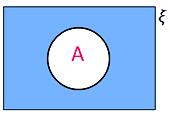
1. ξ is a universal set and A is a subset of the universal set.
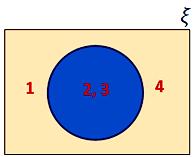
A = {2, 3}
• Draw a rectangle which represents the universal set.
• Draw a circle inside the rectangle which represents A.
• Write the elements of A inside the circle.
• Write the leftover elements in ξ that is outside the circle but inside the rectangle.
• Shaded portion represents A’, i.e., A’ = {1, 4}
2. ξ is a universal set. A and B are two disjoint sets but the subset of the universal set i.e., A ⊆ ξ, B ⊆ ξ and A ∩ B = ф
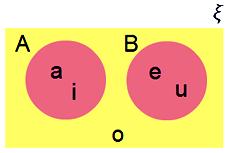
For example;
ξ = {a, e, i, o, u}
A = {a, i}
B = {e, u}
• Draw a rectangle which represents the universal set.
• Draw two circles inside the rectangle which represents A and B.
• The circles do not overlap.
• Write the elements of A inside the circle A and the elements of B inside the circle B of ξ.
• Write the leftover elements in ξ , i.e., outside both circles but inside the rectangle.
• The figure represents A ∩ B = ф
3. ξ is a universal set. A and B are subsets of ξ. They are also overlapping sets.
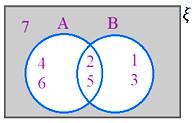
For example;
Let ξ = {1, 2, 3, 4, 5, 6, 7}
A = {2, 4, 6, 5} and B = {1, 2, 3, 5}
Then A ∩ B = {2, 5}
• Draw a rectangle which represents a universal set.
• Draw two circles inside the rectangle which represents A and B.
• The circles overlap.
• Write the elements of A and B in the respective circles such that common elements are written in overlapping portion (2, 5).
• Write rest of the elements in the rectangle but outside the two circles.
• The figure represents A ∩ B = {2, 5}
4. ξ is a universal set and A and B are two sets such that A is a subset of B and B is a subset of ξ.
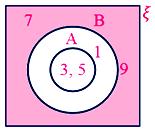
Let ξ = {1, 3, 5, 7, 9}
A= {3, 5} and B= {1, 3, 5}
Then A ⊆ B and B ⊆ ξ
• Draw a rectangle which represents the universal set.
• Draw two circles such that circle A is inside circle B as A ⊆ B.
• Write the elements of A in the innermost circle.
• Write the remaining elements of B outside the circle A but inside the circle B.
• The leftover elements of are written inside the rectangle but outside the two circles.
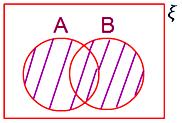
Observe the Venn diagrams. The shaded portion represents the following sets.
(a) A’ (A dash)
(b) A ∪ B (A union B)
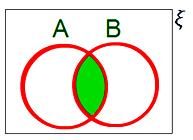
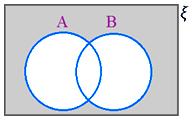
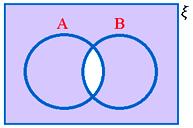
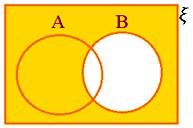
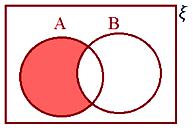
(h) (A – B)’ (Dash of sets A minus B)
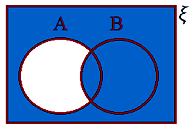
(i) (A ⊂ B)’ (Dash of A subset B)
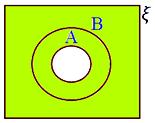
For example;
Use Venn diagrams in different situations to find the following sets.
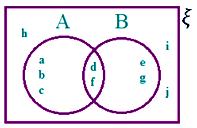
(a) A ∪ B
(b) A ∩ B
(c) A’
(d) B – A
(e) (A ∩ B)’
(f) (A ∪ B)’
Solution:
ξ = {a, b, c, d, e, f, g, h, i, j}
A = {a, b, c, d, f}
B = {d, f, e,
g}
A ∪ B = {elements which are in A or in B or in both}
= {a, b, c, d, e, f, g}
A ∩ B = {elements which are common to both A and B}
= {d, f}
A’ = {elements of ξ, which are not in A}
= {e, g, h, i, j}
B – A = {elements which are in B but not in A}
= {e, g}
(A ∩ B)’ = {elements of ξ which are not in A ∩ B}
= {a, b, c, e, g, h, i, j}
(A ∪ B)’ = {elements of ξ which are not in A ∪ B}
= {h, i, j}